格物
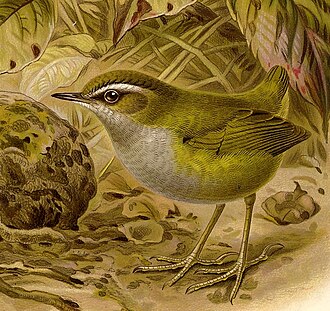
图:Buller, Walter Lawry, A History of the Birds of New Zealand,… · Public domain · Wikimedia Commons
生命之树 › 真核生物 › 动物界 › 真后生动物亚界 › 两侧对称动物 › 后口动物总门 › 脊索动物门 › 脊椎动物亚门 › 有颌下门 › 肉鳍鱼总纲 › 四足形类 › 希望螈目 › 四足总纲 › 爬行动物 › 坚尾龙类 › 鸟纲 › 今鸟亚纲 › 今颚下纲 › 新鸟总目 › 雀形目
刺鹩科科
Acanthisittidae
刺鹩科 是雀形目的一个科,现仅存2属2种,为新西兰特有种,有时也被称为“新西兰鹩”。体型较小,腿和喙较长,生活在山区。
刺鹩属(Acanthisitta)
刺鹩
异鹩属(Xenicus)
†丛异鹩
石异鹩
†斯蒂芬岛异鹩
粗腿鹩属(Pachyplichas)
†南岛粗腿鹩
†北岛粗腿鹩
长嘴鹩属(Dendroscansor)
†长嘴鹩
摘自维基百科「刺鹩科」,CC BY-SA 4.0
- 学名
- Acanthisittidae
- 分类等级
- 科
- 上级类群
- 雀形目
- 大类
- 鸟类
- 命名
- 卡尔·雅各布·松德瓦尔,1872 年
- 数据库
- NCBI 分类 · GBIF
下级类群(1)
- 异鹩属 Xenicus 属
百科正文
- 刺鹩属(Acanthisitta)
- 刺鹩(Acanthisitta chloris)
- 异鹩属(Xenicus)
- †丛异鹩(Xenicus longipes)
- 石异鹩(Xenicus gilviventris)
- †斯蒂芬岛异鹩(Xenicus lyalli)
- 粗腿鹩属(Pachyplichas)
- †南岛粗腿鹩(Pachyplichas yaldwyni)
- †北岛粗腿鹩(Pachyplichas jagmi)
- 长嘴鹩属(Dendroscansor)
- †长嘴鹩(Dendroscansor decurvirostris)
以上内容摘自维基百科「刺鹩科」,按 CC BY-SA 4.0 使用,去掉了参考文献、外部链接等尾部小节,公式改写成了纯文本。全文、配图和出处见原文。
英文维基百科补充中文条目比较短,下面是英文条目「New Zealand wren」的原文
The New Zealand wrens are a family (Acanthisittidae) of tiny passerines endemic to New Zealand. They were represented by seven Holocene species in four or five genera, although only two species in two genera survive today. They are understood to form a distinct lineage within the passerines, but authorities differ on their assignment to the oscines or suboscines (the two suborders that between them make up the Passeriformes). More recent studies suggest that they form a third, most ancient, suborder Acanthisitti and have no living close relatives at all. They are called "wrens" because of similarities in appearance and behaviour to the true wrens (Troglodytidae) but are not members of that family.
New Zealand wrens are mostly insectivorous foragers of New Zealand's forests, with one species, the New Zealand rock wren, being restricted to alpine areas. Both the remaining species are poor fliers and four of the five extinct species are known or suspected to have been flightless. Along with the long-legged bunting from Tenerife, one of the Canary Islands, they are the only passerines known to have lost the ability to fly. Of the species for which the plumage is known, they are drab-coloured birds with brown-green plumage. They form monogamous pair bonds to raise their young, laying their eggs in small nests in trees or amongst rocks. They are diurnal and like all New Zealand passerines, are, for the most part, sedentary.
Like many New Zealand birds, New Zealand wrens suffered several extinctions after the arrival of humans in New Zealand. Of the seven Holocene species, only two survive today. The South Island stout-legged wren, North Island stout-legged wren, and long-billed wren became extinct after the arrival of the Māori and the Polynesian rat. They are known to science only from
subfossil remains. At the same time, Lyall's wren became extinct on the main islands and survived only as a relict population on Stephens Island in the Cook Strait. Lyall's wren and the bushwren became extinct after the arrival of Europeans in 1895 and 1972 respectively. Of the two remaining species, the rifleman is still common in both the North and South Islands. The New Zealand rock wren is restricted to the alpine areas of the South Island and is considered endangered.
Taxonomy and systematics
The taxonomy of the New Zealand wrens has been a subject of considerable debate since their discovery, although they have long been known to be an unusual family. In the 1880s, Forbes assigned the New Zealand wrens to the suboscines related to the cotingas and the pittas (and gave the family the name Xenicidae). Later, they were thought to be closer to the ovenbirds and antbirds. Sibley's 1970 study comparing egg-white proteins moved them to the oscines, but later studies, including the 1982 DNA-DNA hybridisation study, suggested the family was a sister taxon to the suboscines and the oscines.
Description
New Zealand wrens are tiny birds; the rifleman is the smallest of New Zealand's birds. Their length ranges from 7 to 10 cm and their weight ranges from as little as 5–7 g for the rifleman, to an estimated 50 g for the extinct stout-legged wren. The New Zealand rock wren (and probably the bushwren) weighs between 14 and 22 g and the extinct long-billed wren weighed around 30 g.
The plumage of the New Zealand wrens is only known for the four species seen by European scientists. All these species have dull green and brown plumage and all except Lyall's wren have a prominent supercilium above the eye.
Distribution and habitat
The New Zealand wrens are endemic and restricted to the main and offshore islands of New Zealand; they have not been found on any of the outer islands such as the Chatham Islands or the Kermadec Islands. Prior to the arrival of humans in New Zealand (about 1280 CE), they had a widespread distribution across both the North and South Islands and on Stewart Island. The range of the rifleman and bushwren included southern beech forest and podocarp-broadleaf forest, with the range of the bushwren also including coastal forest and scrub, particularly the Stewart Island subspecies. Currently, the New Zealand rock wren is confined to alpine and subalpine zones (900–2500 m altitude) on the South Island.
以上节选摘自英文维基百科「New Zealand wren」,按 CC BY-SA 4.0 使用,去掉了参考文献、外部链接等尾部小节,公式改写成了纯文本。篇幅所限,较长的小节只摘了开头一部分,有的小节没有收;全文、配图和出处见原文。