格物
柯西动量方程
Cauchy momentum equation
equation
The Cauchy momentum equation is a vector partial differential equation put forth by Augustin-Louis Cauchy that describes the non-relativistic momentum transport in any continuum.
摘自英文维基百科「Cauchy momentum equation」(英文维基百科,暂无中文条目),CC BY-SA 4.0
- 类型
- 物理定律
- 命名来源
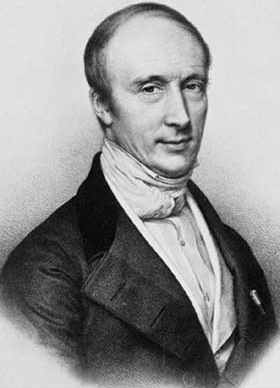
- 奥古斯丁·路易·柯西
- 学科
- 物理学
- 上级概念
- 偏微分方程
相关科学家
百科正文
本条目暂无中文维基百科条目,下面是英文维基百科原文。
Main equation
In convective (or Lagrangian) form the Cauchy momentum equation is written as: Du/Dt=1/(ρ)∇ · σ +a
where u is the flow velocity vector field, which depends on time and space, (unit: m/s) t is time, (unit: s) Du/Dt is the material derivative of u, equal to ∂ ₜu +u · ∇ u, (unit: (公式略)) ρ is the density at a given point of the continuum (for which the continuity equation holds), (unit: (公式略)) σ is the stress tensor, (unit: Pa=N/m²=kg· m⁻¹· s⁻²) (公式略) is a vector containing all of the body accelerations (sometimes simply gravitational acceleration), (unit: (公式略)) (公式略) is the divergence of stress tensor. (unit: Pa/m=kg· m⁻²· s⁻²)
Commonly used SI units are given in parentheses although the equations are general in nature and other units can be entered into them or units can be removed at all by nondimensionalization.
Differential derivation
Let us start with the generalized momentum conservation principle which can be written as follows: "The change in system momentum is proportional to the resulting force acting on this system". It is expressed by the formula: (公式略)
where p (t) is momentum at time t, and (公式略) is force averaged over Δ t. After dividing by Δ t and passing to the limit Δ t→ 0 we get (derivative): dp/dt=F
Let us analyse each side of the equation above.
Right side
We split the forces into body forces F ₘ and surface forces F ₚ
F =F ₚ+F ₘ
Surface forces act on walls of the cubic fluid element. For each wall, the X component of these forces was marked in the figure with a cubic element (in the form of a product of stress and surface area e.g. -σ ₓₓ dy dz with unit (公式略)).
Adding forces (their x-components) acting on each of the cube walls, we get: (公式略)
Integral derivation
Applying Newton's second law (ith component) to a control volume in the continuum being modeled gives: maᵢ=Fᵢ
Then, based on the Reynolds transport theorem and using material derivative notation, one can write (公式略)
where Ω represents the control volume. Since this equation must hold for any control volume, it must be true that the integrand is zero, from this the Cauchy momentum equation follows. The main step (not done above) in deriving this equation is establishing that the derivative of the stress tensor is one of the forces that constitutes Fi.
Conservation form
The Cauchy momentum equation can also be put in the following form:
simply by defining: (公式略)
where j is the momentum density at the point considered in the continuum (for which the continuity equation holds), F is the flux associated to the momentum density, and f contains all of the body forces per unit volume. u ⊗ u is the outer product of the velocity with itself.
Here j and f have same number of dimensions N as the flow speed and the body acceleration, while F, being a tensor, has N2.
In the Eulerian forms it is apparent that the assumption of no deviatoric stress brings Cauchy equations to the Euler equations.
Convective acceleration
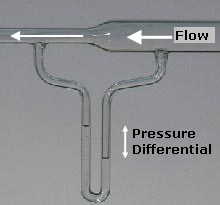
A significant feature of the Navier–Stokes equations is the presence of convective acceleration: the effect of time-independent acceleration of a flow with respect to space. While individual continuum particles indeed experience time dependent acceleration, the convective acceleration of the flow field is a spatial effect, one example being fluid speeding up in a nozzle.
Regardless of what kind of continuum is being dealt with, convective acceleration is a nonlinear effect. Convective acceleration is present in most flows (exceptions include one-dimensional incompressible flow), but its dynamic effect is disregarded in creeping flow (also called Stokes flow). Convective acceleration is represented by the nonlinear quantity u ⋅ ∇u, which may be interpreted either as (u ⋅ ∇)u or as u ⋅ (∇u), with ∇u the tensor derivative of the velocity vector u. Both interpretations give the same result.
Stresses
The effect of stress in the continuum flow is represented by the ∇p and ∇ ⋅ τ terms; these are gradients of surface forces, analogous to stresses in a solid. Here ∇p is the pressure gradient and arises from the isotropic part of the Cauchy stress tensor. This part is given by the normal stresses that occur in almost all situations. The anisotropic part of the stress tensor gives rise to ∇ ⋅ τ, which usually describes viscous forces; for incompressible flow, this is only a shear effect. Thus, τ is the deviatoric stress tensor, and the stress tensor is equal to: σ =-pI +τ
where I is the identity matrix in the space considered and τ the shear tensor.
All non-relativistic momentum conservation equations, such as the Navier–Stokes equation, can be derived by beginning with the Cauchy momentum equation and specifying the stress tensor through a constitutive relation.
External forces
The vector field a represents body forces per unit mass. Typically, these consist of only gravity acceleration, but may include others, such as electromagnetic forces. In non-inertial coordinate frames, other "inertial accelerations" associated with rotating coordinates may arise.
Often, these forces may be represented as the gradient of some scalar quantity χ, with a = ∇χ in which case they are called conservative forces. Gravity in the z direction, for example, is the gradient of −ρgz. Because pressure from such gravitation arises only as a gradient, we may include it in the pressure term as a body force h = p − χ. The pressure and force terms on the right-hand side of the Navier–Stokes equation become -∇ p+a =-∇ p+∇ χ =-∇ (p-χ)=-∇ h.
It is also possible to include external influences into the stress term σ rather than the body force term.
Nondimensionalisation
In order to make the equations dimensionless, a characteristic length r0 and a characteristic velocity u0 need to be defined. These should be chosen such that the dimensionless variables are all of order one. The following dimensionless variables are thus obtained: (公式略)
- Substitution of these inverted relations in the Euler momentum equations yields: (公式略)
- and by dividing for the first coefficient: (公式略)
- Now defining the Froude number: (公式略)
- the Euler number: (公式略)
and the coefficient of skin-friction or the one usually referred as 'drag coefficient' in the field of aerodynamics: (公式略)
by passing respectively to the conservative variables, i.e. the momentum density and the force density: (公式略)
the equations are finally expressed (now omitting the indexes):
Cauchy equations in the Froude limit Fr → ∞ (corresponding to negligible external field) are named free Cauchy equations:
3D explicit convective forms
Cartesian 3D coordinates
For asymmetric stress tensors, equations in general take the following forms: (公式略)
Cylindrical 3D coordinates
Below, we write the main equation in pressure-tau form assuming that the stress tensor is symmetrical ( (公式略)): (公式略)
以上节选摘自英文维基百科「Cauchy momentum equation」,按 CC BY-SA 4.0 使用,去掉了参考文献、外部链接等尾部小节,公式改写成了纯文本。篇幅所限,较长的小节只摘了开头一部分,有的小节没有收;全文、配图和出处见原文。