格物
- 类型
- 定理
- 命名来源
- 奥古斯丁·路易·柯西、雅克·阿达马
- 属于
- 数学定理列表
- 研究学科
- 微积分
- 学科
- 物理学、数学
相关科学家
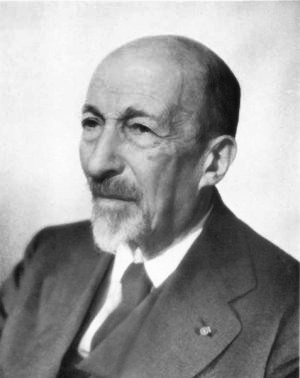
百科正文
公式陈述
对于单一复数变量“z”的形式幂级数 f(z)=∑ ₙ₌₀^(∞)cₙ(z-a)ⁿ.
- 上式中 a,cₙ∈ C,
- 则该级数收敛半径 R 由下式给出: (公式略)
- 其中 limsup 定义为 (公式略)
其中 sup 为集合的最小上界。
以上内容摘自维基百科「柯西-阿达马公式」,按 CC BY-SA 4.0 使用,去掉了参考文献、外部链接等尾部小节,公式改写成了纯文本。全文、配图和出处见原文。
英文维基百科补充中文条目比较短,下面是英文条目「Cauchy–Hadamard theorem」的原文
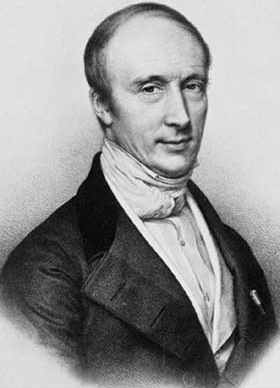
In mathematics, the Cauchy–Hadamard theorem is a result in complex analysis named after the French mathematicians Augustin Louis Cauchy and Jacques Hadamard, describing the radius of convergence of a power series. It was published in 1821 by Cauchy, but remained relatively unknown until Hadamard rediscovered it. Hadamard's first publication of this result was in 1888; he also included it as part of his 1892 Ph.D. thesis.
Theorem for one complex variable
Consider the formal power series in one complex variable z of the form f(z)=∑ ₙ₌₀^(∞)cₙ(z-a)ⁿ
where a,cₙ∈ C.
Then the radius of convergence R of f at the point a is given by (公式略)
where lim sup denotes the limit superior, the limit as n approaches infinity of the supremum of the sequence values after the nth position. If the sequence values is unbounded so that the lim sup is ∞, then the power series does not converge near a, while if the lim sup is 0 then the radius of convergence is ∞, meaning that the series converges on the entire plane.
Proof
Without loss of generality assume that a=0. We will show first that the power series ∑ ₙcₙzⁿ converges for |z|<R, and then that it diverges for |z|>R.
First suppose |z|<R. Let t=1/R not be 0 ± ∞.
For any ε >0, there exists only a finite number of n such that (公式略).
Now |cₙ|<(t+ε)ⁿ for all but a finite number of cₙ, so the series ∑ ₙcₙzⁿ converges if |z|<1/(t+ε). This proves the first part.
Conversely, for ε >0, |cₙ|≥ (t-ε)ⁿ for infinitely many cₙ, so if |z|=1/(t-ε)>R, we see that the series cannot converge because its nth term does not tend to 0.
Theorem for several complex variables
Let α be an n-dimensional vector of natural numbers ( α =(α ₁,⋯,α ₙ)∈ N ⁿ) with ‖α ‖:=α ₁+⋯ +α ₙ, then f(z) converges with radius of convergence ρ =(ρ ₁,⋯,ρ ₙ)∈ R ⁿ, ρ ^(α)=ρ ₁^α ₁⋯ ρ ₙ^α ₙ if and only if (公式略)
of the multidimensional power series (公式略)
Proof
- From
- Set z=a+tρ
- ( (zᵢ=aᵢ+tρ ᵢ). Then (公式略)
This is a power series in one variable t which converges for |t|<1 and diverges for |t|>1. Therefore, by the Cauchy–Hadamard theorem for one variable (公式略)
Setting |cₘ|ρ ^(m)=max _(‖α ‖=μ)|c_(α)|ρ ^(α) gives us an estimate |cₘ|ρ ^(m)≤ ∑ _(‖α ‖=μ)|c_(α)|ρ ^(α)≤ (μ +1)ⁿ|cₘ|ρ ^(m).
- Because (公式略) μ → ∞
- | (公式略)
- Therefore (公式略)
以上内容摘自英文维基百科「Cauchy–Hadamard theorem」,按 CC BY-SA 4.0 使用,去掉了参考文献、外部链接等尾部小节,公式改写成了纯文本。全文、配图和出处见原文。